
To be, or not to be, Like Other Girls:
Internalised Misogyny, Video Games and Community.
Somewhere in the world, a woman is turning on her gaming device.
She's excited.
She has her head set on,
and her controller in hand.
Eagerly, she joins a multiplayer match
She speaks in voice chat,
"Hi team! Any mics?"
Silence follows.
Then, as the game progresses, she hears,
"You suck!"
"I bet she's boosted."
"Go back to the kitchen."
"Get good, bitch."
Her excitement dissapears.
A knot forms in her stomach.
She turns off her microphone and mutes her teammates, vowing to stay silent.
She doesn't want to get her feelings hurt any more.
She keeps playing,
but she isn't having fun anymore.
She feels humiliated.
She feels isolated.
Unfortunately, she is not the only woman to experience gendered attacks while playing video games.
A 2021 survey found that
77%
The report found that these attacks include:
-
Unsolicited advice
-
Gatekeeping
-
Men leaving the game when finding out the player is a woman
-
Purposefully throwing (sabotaging) games.
of 900 respondents across China, Germany, and the US experienced gender-specific harassment while gaming.
Many women experience these attacks. TikTok user Rolease (2023) recorded an experience she had playing the multiplayer video game Valorant (video trimmed for time purposes). Here, her teammates are openly sexist towards her and target her because she is a woman.


click on video to play
This blatant misogyny towards women can be seen all over social media. For example, after a loss in the multiplayer video game Marvel Rivals, this player made a public TikTok video claiming that women make the video game experience worse, and that to play video games, women "need to understand how men communicate" (video trimmed for time purposes).
click on video to play
59%
of the respondents to the 2021 survey use male or non-gendered identities when playing online.
The message is clear: to be safe in multiplayer spaces, some women may feel the need to pretend they are someone and/or something they are not.
This is not the only evidence that shows how misogyny impacts women on video games.
Some researchers found that the lack of social support for females on video game platforms frequently leads to females playing alone, playing anonymously, and moving teams and groups regularly. Additionally, these researchers report that the lack of social support in video games often leads to female gamers experiencing anxiety and loneliness, and impacts how much they enjoy gaming.
But, here's where our gamers story gets complicated.
Not all the harassment she experiences comes from men.
Sometimes, it comes from other women.
PART II:
Women-on-Women misogyny in Video Games.
“I think it hurts so much more because when I hear a woman I immediately feel like I have an ally and I’ll be safe to speak on voice this game. The disappointment is definitely I think rooted in that aspect of thinking you’ve found that ally and then to be treated the way misogynistic male gamers treat you"
-Ruotsalainen & Meriläine, 2025.
She joins queue and gets into a new match.
In this match, she hears a new voice, a womans voice.
Relief washes over her.
She breaks her vow of staying silent, hoping to make a friend.
but, just like before, she hears,
"You are just playing for attention. Stop being such an attention whore."
"Of course you play a healer. Typical one-trick woman."
"You play like a little girl."
"You're just like the other girls, so bad at video games."
"Go back to your cosy games, your aim is trash."
"Unlike you,
I'm not like other girls,
and I actually know how to play the game."
"not like other girls"
"not like other girls"
"not like other girls"
"not like other girls"
"i'm not like other girls"
“'Not like other girls'” is both a meme and a stereotype. The phrase is most commonly used on social media to refer to women who try to distance themselves from other women by declaring that they are different from other women and by rejecting traditionally feminine things (Means, 2021).
Closely related to the trope of “not like other girls” is the term “pick-me girl”. Terry Ward reports that the origin of the ‘pick-me’ girl comes from an episode of Grey’s Anatomy, where Meredith Grey begged her love interest to choose her over his wife, stating, “Pick me. Choose me. Love me.”
Today, the term “pick-me” describes women who are perceived to be seeking male attention and approval by putting other women down. In multiplayer video game contexts, this phrase is also often used interchangeably with “e-girl” or “gamer girls”.
In gaming spaces, this manifests as:
-
mocking feminine usernames
-
harassing and criticising women who use face cams
-
dismissing women who enjoy ‘feminine’ in-game objects and characters (e.g. ‘girly’ skins, support characters)
-
feeling/claiming superiority by aligning themselves with male gamers
-
and more.
BUT,
the issue is more than just harassment,
it's structural.
PART Iii:
Femininity and punishment.
"I love makeup, and I wear pink all the time, like almost my entire closet is pink. My room is pink too. It only makes sense that my pc set up and in game cosmetics are pink... and sometimes, I feel like people see the pink gun and think I might be bad at the game"
-Hunt, 2026.
Certain women are punished more than others.
Women who embody hyperfemininity are often labelled as
"attention-seeking",
"fake gamers", or
"doing it for male validation".
In gaming contexts, this can mean pink skins, pink gaming setups, soft/and or high-pitched voices.
On the other hand, women who reject traditional notions of femininity may be more likely to be accepted within gaming spaces. But, to do so, they must distance themselves from other women.
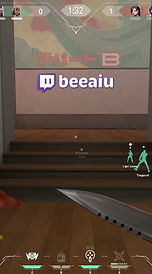
Press of video to play.
Here's an example provided by TikTok user Beeaiu.
“Rather than male‐seeking, most of those women assume the best way not to be harassed/associated with negative things women are portrayed as is through showing others that they are not like those weak, incapable women”.
This is where internalised misogyny comes into play and intersects with competetition between women. If femininity is punished, distancing yourself can feel protective and can become a survival adaptation to protect yourself from experiencing misogyny.
If association with "other girls" lowers your power, control, safety, and social currency, rejecting them can feel empowering. When survival is rewarded, kindness becomes risky. So you may put them down, or chalk them up to being bad at video games, like many stereotypes claim.
This is where it becomes a cycle of internalised misogyny. A report found that females who experience the prejudiced and unsubstantiated perceptions that females are not good at gaming may adopt the same beliefs and internalise the stereotype.
But, even if you adapt to survive in these conditions by targeting other women to distance yourself from them
THE SYSTEM STILL WINS
because instead of questioning why femininity is criticised and is seen as a bad thing, women are left policing how other women act, enjoy, purchase, etc.
Another report found that, in some cases, women’s hostility and aggression can be unjustly seen as gendered attacks, expressions of internalised misogyny, and seeking male validation by other women. By determining any act of aggression or hostility as ‘pick-me’ behaviour, the creation of an ideal gaming woman, who is non-hostile, non-aggressive, regulated and displays solidarity to women to prevent being labelled a ‘pick-me’. This furthers gendered expectations for gaming women. (Ruotsalainen & Meriläine, 2025)
The real culprits are not the "pick-me's", "e-girls", or "gamer girls"
its the patriarchal systems and structures that reward women for distancing themselves from both femininity and other women.
PART IV:
BREAKING THE CYCLE.
"The sad truth is—until society stops perceiving women as incapable, stupid, weak etc. there are always going to be 'not like other girls' women who are trying to avoid negative stigma by distancing themselves from women"
SO WHAT INTERRUPTS THIS PATTERN?
Research suggests visibility and solidarity among women in gaming spaces.
Some call for the need of women openly and visibly supporting each other within the gaming community, with reinforcement from men. Others found that endorsing a positive feminist identity might prevent women from internalising the negative stereotypes, beliefs, and prejudices towards women that they often experience in video games.
When women openly and proudly identify and stand with other women, rather than distancing themselves, the patriarchal hierarchy is disrupted. Instead, support replaces competition.
Our gamer turns off her gaming console for the day.
Maybe she was harassed.
Maybe people made sexist jokes.
Maybe her and her skills were dismissed.
Maybe she was labelled a "pick-me",
maybe she was labelled "too girly",
or maybe both,
because in our society and in our systems, women are criticised either way.
Too feminine? You're fake and seeking male validation.
Too masculine? You're "not-like other girls" and seeking male validation.
Good at the game? You're boosted.
Bad at the game? Typical, you're a woman.
In our society and in our systems, the rules of the game are stacked against us and are unwinnable,
unless the game changes,
Unless WE change the game.
WHAT CAN YOU DO?
Support women's e-sports leagues.
Call out misogyny in text or voice chat.
Refuse to laugh at or entertain sexist jokes.
Like these!


Compliment other womens skill and talent without comparing.
Be vocal and publicly support about other women in gaming spaces.
Find women-only gaming spaces, like Discord servers, and make friends with like-minded women.
My favourites!
Can't find any spaces that fit your needs? make one.
Check these ones out!
Don't know where to start? Here's a tutorial!
Challenge the idea that there is an ideal way to act on online multiplayer games as a woman and that femininity reduces skills and credibility.



Because the end goal isn't to become "not like other girls", the end goal is to prevent internalising the misogyny we experience online, which makes it safer to be any kind of girl, unconditionally (or no girl at all).
GAME OVER
START NEW GAME?
Because dismantling the misogyny many of us experience in gaming spaces isn't about hiding away by muting yourself or closing the game.
It's about making change.
It's about finding community.
It's about playing differently.
Together.